
What to Look for in a Custom Rotary Solenoid Manufacturer
Oct 30, 2026
Dongguan, Guangdong Oct 29, 2026 (Issuewire.com) - Custom Rotary Solenoid Manufacturer
Rotary solenoids are widely used in modern industrial automation, electronics and mechanics. Linear solenoids operate using the electromagnetic field and producing linear motion. Rotary solenoids operate using the electromagnetic field and producing rotary motion with a limited angle. This feature makes the devices useful in various applications involving mechanical switching, locking, indexing, positioning and control.
However, selecting the correct rotary solenoid for the application is not always easy. Various applications require specific rotation angle, torque level, operating voltage, response time, mounting dimensions and duty cycle. In some cases, especially if the OEM product has space limitations or unique mechanical design, it is impossible to find a standard part meeting all the requirements.
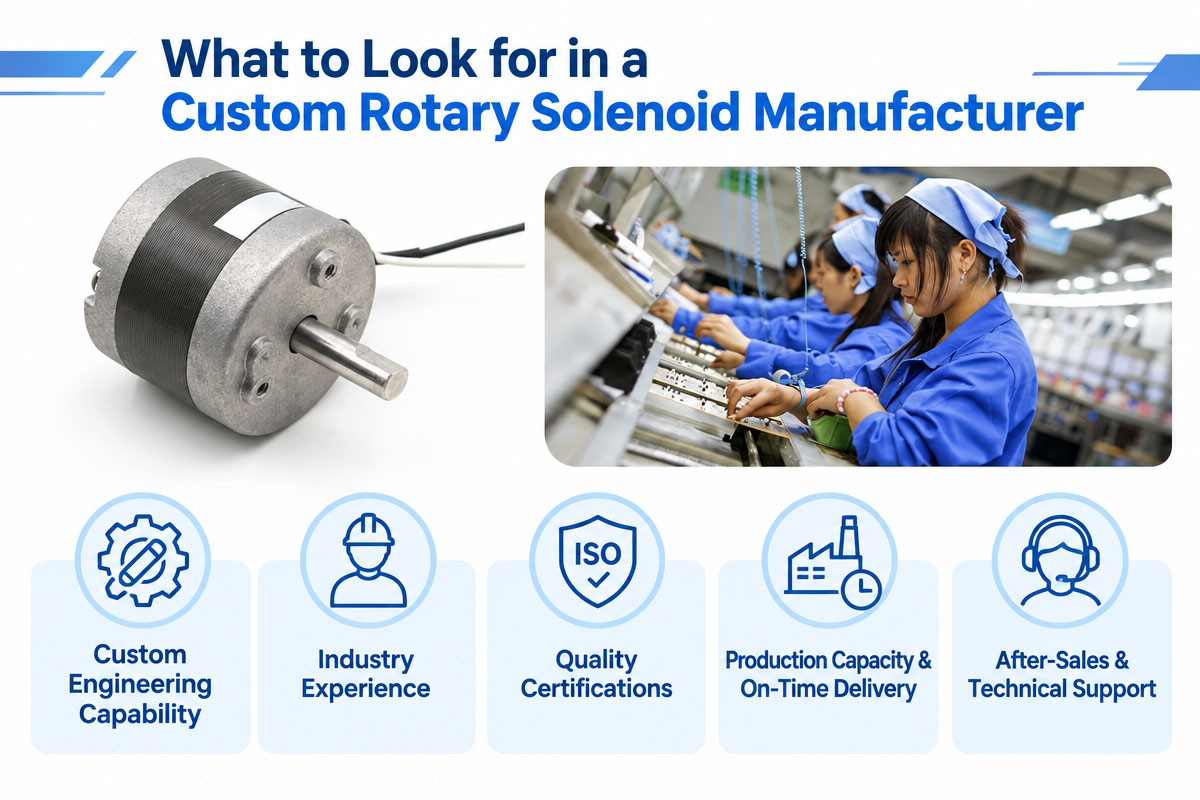
Therefore, the choice of a reliable rotary solenoid manufacturer is a key part of the product development process. The manufacturer should be able to assist in evaluation of technical requirements, creation of custom solution, prototyping and manufacturing processes development.
This guide provides key points to consider when choosing a custom rotary solenoid manufacturer and ways to evaluate a supplier for your next OEM project.
- Know Your Application requirementFirst
Before contacting any rotary solenoid manufacturer, define the purpose of using the component in your equipment. Specific requirements will help the manufacturers to assess the feasibility and suggest a suitable design.
1.1 Rotation Angle
Rotary solenoids are limited-angle devices,25° 45°, 90° and 180° being the most common, but other angles may be available depending on the mechanism.
It is necessary to specify the required rotation angle, starting point, end point and direction of movement. Also, engineers should indicate if the mechanism should return to position when powered off or stay at the last position.
1.2 Torque Requirement
Torque is the rotational force to move a connected mechanism. An actuator spinning freely, without load, can behave differently when connected to a spring, latch, lever or other mechanism.
If you request a quotation, be sure to specify the required torque for the whole operating range if possible. Starting torque, end-of-stroke torque, spring force, friction and external load should be considered.
1.3 Operating Voltage & Current
Common rotary solenoid applications use DC power supply, 5V, 12V or 24V being the most common options. The voltage needed is determined by the coil design, current available, torque requirement and operating conditions.
The manufacturer should not assume that a particular voltage will automatically provide the desired performance, but should investigate electrical requirements.
1.4 Operating Frequency and Duty Cycle
Duty cycle is the way to express the percentage of time when the device is powered on. Some rotary solenoids are designed for short pulses, other can endure long energization under certain conditions.
If your application requires frequent switching or continuous power, it is necessary to specify the operating frequency and power on time. This data will help the manufacturer to assess the heating, coil design and service life requirements.
1.5 Mounting Dimensions
Lack of space often determines whether a standard rotary solenoid can be used. Maximal diameter. Total length. Locations of mounting holes. Shaft dimensions. Connector requirements. Surrounding clearance.
If there is a mechanism, a mechanical drawing or 3D CAD model will help the manufacturer to understand the installation constraints and identify any potential issues in the design.
- Assess the Manufacturer's Engineering Capabilities
Any reputable manufacturer of rotary solenoids should be able to do more than provide you with a catalog and unit price. Custom projects usually require detailed engineering analysis to determine a suitable design.
2.1 Custom Development & Design
In some OEM applications, a special rotation angle, torque profile, return spring, shaft arrangement or compact housing is needed. The manufacturer should be able to assess these requirements and determine which specifications can be provided.
Ask the supplier if they are able to design a new actuator, modify existing design or recommend a different arrangement of actuators.
2.2 Design of Magnetic Circuit and Coil
The performance of the rotary solenoid is determined by the coil and the magnetic circuit. The forces and torques generated depend on the magnetic materials, air gaps, winding specifications and mechanical geometry.
All these factors should be considered together by a qualified engineering team, instead of voltage being the only design parameter.
2.3 Mechanical Integration
Rotary solenoids are a part of the larger mechanism. Actual performance can be influenced by shaft alignment, spring resistance, mounting rigidity, friction and external loads.
A manufacturer having the knowledge about mechanical integration can help you to identify potential issues prior to tooling and mass production.
2.4 Technical Writing
when working across international time zones, straightforward communication becomes even more important. The supplier should be able to evaluate drawings, explain technical limitations and provide meaningful updates during development.
A structured process of requirements review and engineering issue resolution can minimize misunderstandings and reduce development cycle times.
- Confirm Manufacturing Capabilities and Quality Control
The quality of a rotary solenoid depends on the design and manufacturing processes used to produce it.
3.1 Manufacturing Processes in-house
Depending on the design of the product, manufacturing may include metal stamping, machining, plastic injection molding, coil winding, assembly and tooling development.
When evaluating a supplier, it is necessary to find out which processes are performed in-house and which are outsourced. Therefore, in-house capabilities can provide better coordination across manufacturing stages, but their value depends on process control and execution.
3.2 Consistency of Production
This does not mean that a successful prototype guarantees consistent mass production. Variations in coil resistance, dimensions of components, assembly alignment and spring characteristics can affect performance.
Ask about the manufacturer's control of critical dimensions and electrical characteristics and whether inspection criteria are defined for production lots.
3.3 Validation & Testing
The proper test process will be similar to the intended application. Depending on the design it may include:
Verification of rotation angle.
Torque testing over the operating range
- Coil resistance and current measurements·
Response time measurement.
- Temperature-rise tests.
3.5 Cycle-life or endurance testing.
- Verification of mounting dimensions and mechanical connections.
- Not all tests are necessary for every project. Validation plan should be based on product specification, operating environment and customer quality requirements.
3.6 Management Systems for Quality
Quality management certifications can be valuable evidence of the documented processes of the supplier. However, certification does not guaranty that a given product will meet all requirements.
Evaluate certification scope, product standards, traceability and applicable inspection documents for your project.
- Prototype Support Evaluation Prior to Mass Production
When ordering a custom rotary solenoid, one of the most important stages is the development of the prototype.
Prototype gives the engineering team an opportunity to evaluate whether the proposed design works in the real operating conditions. It may also reveal problems that cannot be seen from drawings.
4.1 Functional Test
If possible, use the rotary solenoid with the actual mechanical load. Does it rotate to the required angle? Does it overcome the resistance of the spring? Does it return to the required position? Does it remain at the required position?
For torque-sensitive applications, verify the performance throughout the entire movement, not just the final position.
4.2 Thermal & Electrical Testing
Run the prototype at design voltage, current limit and switching cycle. Measure the temperature and verify that the coil operates within the recommended by the manufacturer parameters.
If the application requires frequent switching, make sure that the component remains consistent over repeated cycles.
4.3 Mechanical Match
Install the prototype in the target equipment and verify the shaft alignment, mounting clearance, connection points and interaction with surrounding components.
This step can help to avoid costly changes after tooling is done.
4.4 Change of Design
A good supplier should be able to analyze test results and determine whether design changes are possible. Spring, shaft, mounting structure, coil or magnetic circuit can be changed.
Prior to the start of the project, agree on the scope of the prototype, who will test it, when it will be delivered and the criteria of approval.
- Consider the total cost, lead time and long-term supply of rotary solenoids
Sometimes it is not economically sound to buy a part with the lowest quoted price on an OEM project. When making a sourcing decision, it is worth considering the development costs, tooling costs, samples, production prices, inspecting and logistics.
5.1 Development and Tooling Costs
Custom rotary solenoids may need specific stamping dies, injection molds, tooling and other production tooling.
Ask your manufacturer for the tooling and development costs breakdown, what it covers, how the engineering changes are treated and what is the process if project specifications change.
5.2 Production prices
Tell me your realistic order quantities and the estimated yearly consumption and get the quotes for realistic order sizes. The manufacturer can have different prices for the prototype, pilot-production and mass-production batches.
Compare the quotations based on the same technical criteria. Avoid choosing the cheapest but inferior performing product.
5.3 Lead Times and Availability
Ask your manufacturer to give the timelines for engineering review, prototype manufacturing, tooling and sample testing and mass production launch.
5.4 Manufacturer's capability and availability
To ensure the long-term supply, you will have to consider the manufacturing and material availability and the capability of the manufacturer to communicate any possible delivery risks.
5.5 Confidentiality and Intellectual Property
Custom components can contain proprietary drawings, custom product design and confidential application information. It is necessary to develop appropriate Confidentiality Agreements and establish who will own the customer-specific designs and tooling prior to releasing any technical documents.
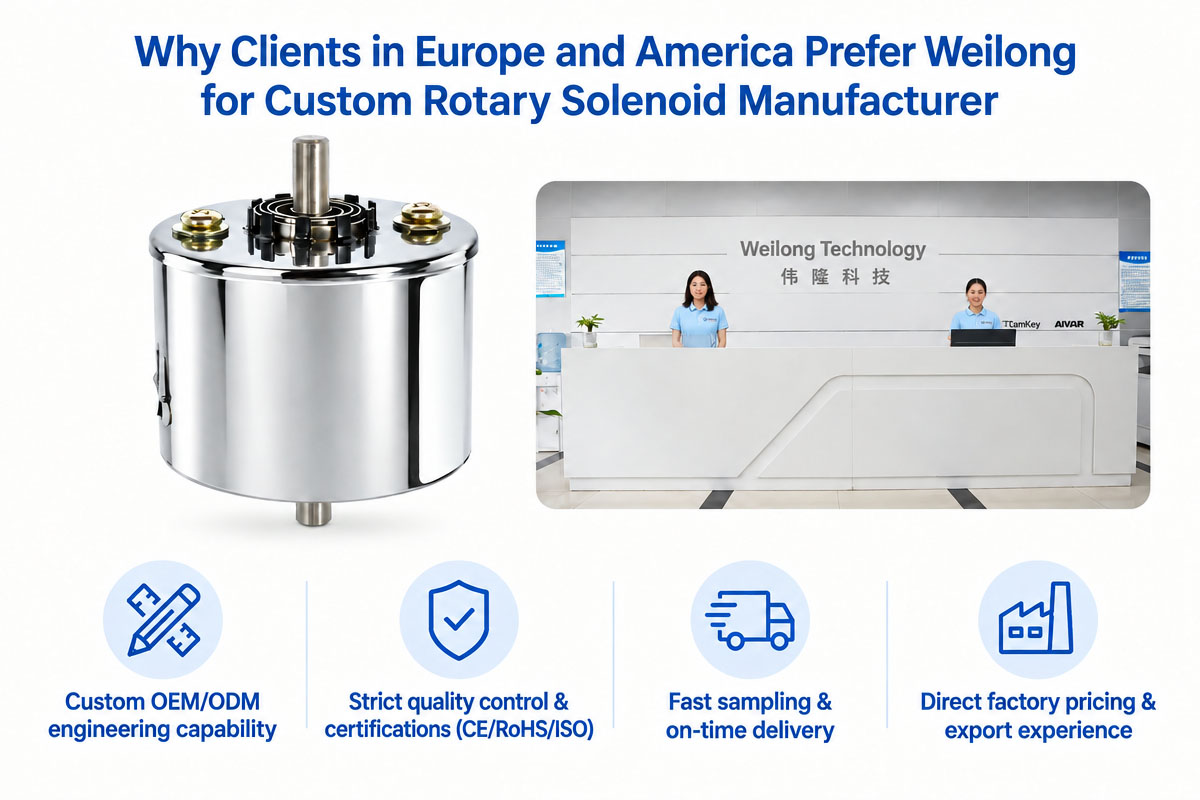
- Why Clients in Europe and America Prefer Weilong
Choosing a rotary solenoid supplier, the European and American OEMs have to sacrifice somewhere between engineering support, manufacturing capability, quality expectations, communication and long-term supply.
Weilong Intelligent Technology (Dongguan) Co., Ltd. has specialized in solenoids and inductor coils since 2007. Our manufacturing capabilities for electromagnetic component production can make us the right partner for those who search for custom solenoids.
6.1 Integrated Production Capabilities
We have in-house capabilities of metal stamping, tooling design and production, plastic injection molding, CNC machining, wire winding, assembling and laboratory testing of the products.
These capabilities can help with custom component development and facilitate the coordination of different manufacturing processes in the project.
6.2 Customization of the parts according to OEM requirements
Depending on the design of the equipment where solenoids will be used, the rotation angles, torque characteristics, operating voltages, physical dimensions, return systems and mounting may vary Unlike other companies which are only standard products suppliers, Weilong is a customized solenoids manufacturer. It can help when the OEM client needs components according to their mechanical design.
6.3 Experience in manufacturing electromagnets
Since 2007 we gained experience in manufacturing of the components, including solenoids and inductor coils. It can be helpful when discussing with the clients our manufacturing capabilities.
In case your project requires specific torque-angle characteristics or spring return, define acceptance criteria in engineering review before approving prototypes.
6.4 Compliance and Quality Management System
We are certified by ISO 9001 and IATF 16949 standards and comply with the applicable regulations like CE, RoHS, and REACH.
As OEM customers should check the scope of applicability of our certificates and the product documentation.
6.5 Development to Manufacturing Capability
Custom rotary solenoid projects are performed through requirements clarification, engineering, prototyping, testing, improvement and production.
Weilong can analyze the client's requirements and develop customized solution suggestions. It is recommended to agree on the appropriateness of design suggestion with the client through testing.
- Questions to Ask Prior Making a Selection
Prior making an order, you should ask your manufacturer:
- Can you deliver the required rotation angle and torque through the stroke?
- 2. Can you customize the shaft, mounting dimension, return spring and electrical specification?
- 3. What tests will be conducted prior shipping samples?
- 4. Can you provide me torque-angle data and electrical performance?
- 5. What manufacturing processes do you perform in-house?
- 6. What are the lead times for prototypes, tooling and mass production?
- 7. What is your quality assurance and batch-to-batch consistency?
- 8. What tooling ownership agreement you offer? 15.
- 9. Can you provide me support with production change and future design changes?
- 10. What do you need to evaluate my application?
- 11. The answers may help you to discriminate between the supplier who will only sell you components and the one providing the support during the whole process of the development.
- Conclusion:
The proper choice of the rotary solenoid manufacturer is a rather crucial step for product development specialists and OEM engineers. The perfect manufacturer should be aware of mechanical and electrical application requirements, possess sufficient customization capabilities, reliable manufacturing processes and should have the capability to validate prototypes before going into mass-production. In any case, torque, rotation angle, operating voltage, duty cycle, mounting dimensions, testing and long-term supply should be considered while choosing a supplier.
9 Frequently Asked Questions (FAQ)
- What does a rotary solenoid manufacturer do?
A rotary solenoid manufacturer produces electromagnets that provide limited angular rotation. It also can perform modifications related to torque, angle of rotation, coil, shaft, spring, mounting design and other mechanical and electrical parameters according to the manufacturer's capabilities.
- What do we need to get a quote on rotary solenoids?
- Minimum angle of rotation
- Torque
- Voltage
- Current limits
- Duty cycle
- Dimensions
- Mounting details
- Return system
- Operating temperature
- Estimated lifetime
- Estimated order quantity
- What difference is there between monostable and bistable rotary solenoid?
The monostable rotary solenoid is designed to return to a preset rest position (usually by a spring action) upon deenergizing. It can be designed to keep one of the two states without being energized (bistable). The choice depends on the mechanism and control requirements.
- Why do we need prototypes for custom rotary solenoids?
Prototype allows validating such parameters as rotation angle, torque, electrical performance, heat dissipation, mounting compatibility and cycle lifetime. Testing under the real working conditions allows finding possible problems prior to making tooling and mass production.
- Will the custom rotary solenoid manufacturer be able to work on an existing sample?
Dependently on their capabilities and information, some manufacturers can evaluate the existing sample. Drawings, dimensions, voltage values, torque values and application information will help engineering team to assess whether replacement or customization is possible.
- When should I consider custom rotary solenoids instead of standard solenoids?
If the torque, rotation angle, mounting dimensions, shaft arrangement, return system, voltage, duty cycle and environmental requirements cannot be met with standard models, the custom design has to be considered. The feasibility review allows determining the necessity of modification of existing design or development of new one.
About Weilong Intelligent Technology (Dongguan) Co., Ltd.
Since 2007, we specialize in solenoids and inductor coils and manufacture customized components for OEM customers.
Website: https://smartsolenoid.com/
Media Contact
Weilong Intelligent Technology Co., Ltd.
+86 136 4298 0378
Building 1, No. 2 Jingxiang Road, Dongcheng District, Dongguan City, Guangdong Province, China (Zip code:523128)
Source :Weilong Intelligent Technology Co., Ltd.
This article was originally published by IssueWire. Read the original article here.
More News







Recommended


Murphy, Kings eye 2-0 lead vs Beermen






YOUR NEWS, OUR NETWORK.
Do you have Great News you want to tell the world?
Be it updates about your business or your community, you can make sure that it’s heard by submitting your story to our network reaching hundreds of news sites across 6 verticals.