Women's Sports

image
Oct 4, 2026

Sabalenka knocked out of China Open

BEIJING — Second-ranked Aryna Sabalenka was bundled out in the third round of the China Open in straight sets by the Czech Republic's Nikola Bartunkova on Sunday. The No. 34-ranked Bartunkova defeated the four-time Grand Slam champion 6-4, 6-3 in just over an hour and a half leaving the tournament without its two top seeds in the first week. Newly-crowned world No. 1 Elena Rybakina was ousted from the tournament on Saturday and will now be joined by Sabalenka in exiting WTA-1000 event in Beijing early. Sabalenka, who was denied a three-peat at the US Open last month by Rybakina, squandered five break points in the first set as her historic struggles in Beijing continued. The 28-year-old Belorussian has never progressed past the quarterfinals at the event. “First of all, I focused on myself, to be calm,” Bartunkova said. “And Aryna, she’s great, she’s a legend, she’s a Grand Slam champion. So, yeah, I’m really happy that I won the match... I’m not a girl who celebrates too much.” Bartunkova will next play 24-year-old Sinja Kraus of Austria, who earlier defeated Dayana Yastremska 6-1, 6-4. Fifth-ranked Mirra Andreeva eased into the fourth round with a 6-4, 6-1 victory over Polina Kudermetova. This year's French Open winner fired six aces and took five of her seven break point opportunities to overwhelm her Uzbek opponent in just in 68 minutes. In the men’s tournament, Hubert Hurkacz beat Karen Khachanov 7-6 (2) 6-2 to make the final four. Later Sunday, top seed and U.S. Open champion Alexander Zverev plays his quarterfinal match against Novak Djokovic.

image
Oct 4, 2026

Asian Games set to close

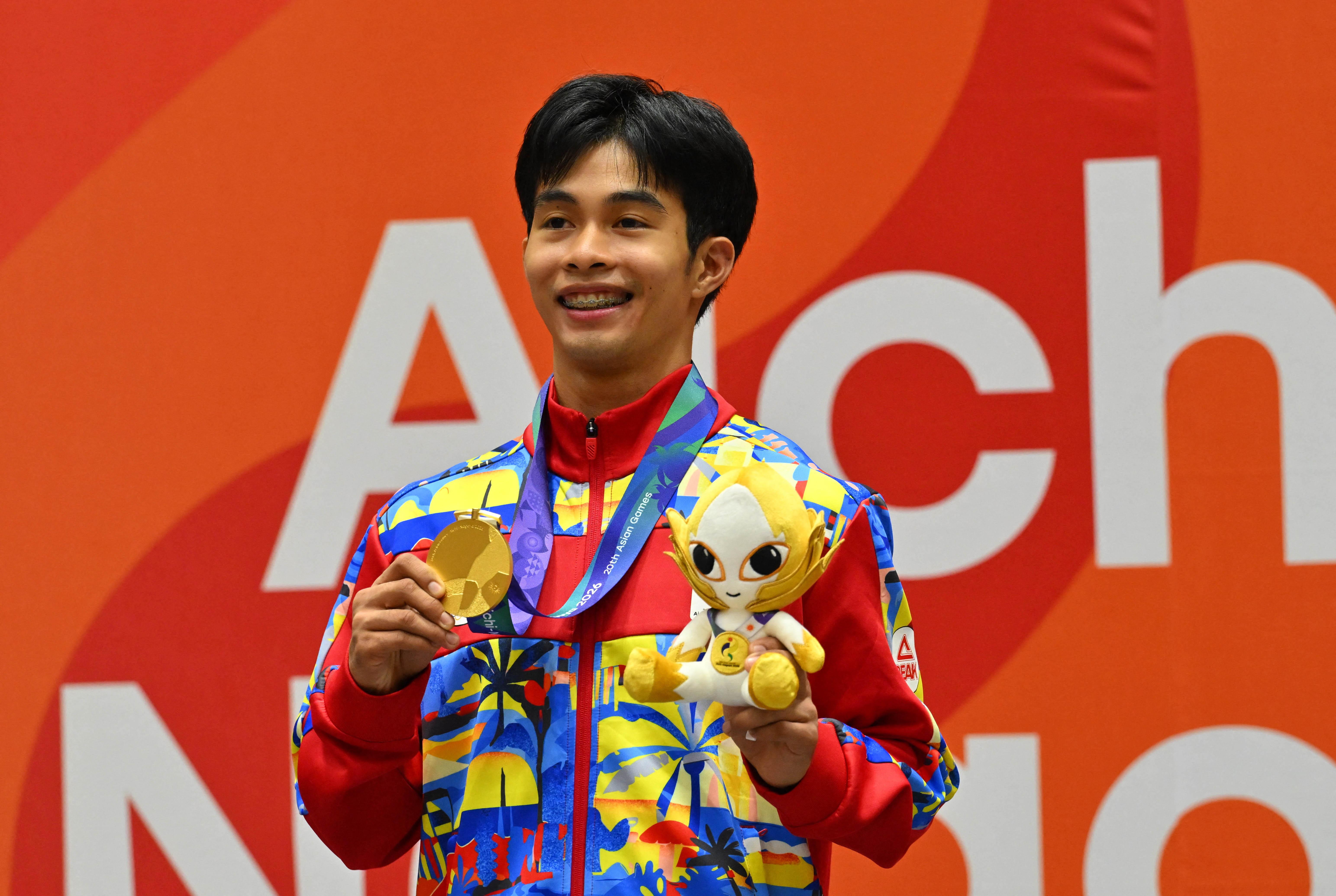
NAGOYA — The Asian Games in Japan will close later Sunday after a fortnight of record-smashing displays from young stars, but marred by mix-ups, patchy crowds and accusations of mismanagement. More than 17,000 athletes and officials, a bigger number than the Olympics, descended on Nagoya and Aichi prefecture for the continent's premier sporting spectacular. Chinese swimming sensation Yu Zidi, just 13, stole the show in the pool with three gold medals, all in Games-record times. She looks set to be a major medal threat at the Los Angeles 2028 Olympics. The schoolgirl was named a Games MVP on Sunday to cap an extraordinary showing that saw her scorch to gold in the 200m butterfly and do the 200m-400m individual medley double. But for that all that, the shy teenager said: "I don't think I am what people describe as a prodigy." Also in the pool, Japanese swimmer Shin Ohashi, himself only 17, smashed the men's 200m breaststroke world record to delight the home crowd. In athletics, where rain tumbled down over several days, Thai sprinter Puripol Boonson did the 100m-200m double and was named men's MVP. "This time there were a lot of global athletes at this event, so the MVP gives me a lot of confidence that I can make the podium in LA," the 20-year-old said. 'Failure grade' With the hours ticking down to the closing ceremony, when Japan will hand over the baton to Doha, top officials were on the defensive. Olympic Council of Asia director general Husain Al-Musallam said "numbers are facts," pointing to 50 world records broken at the Games since they opened on September 19. "The athletes cannot perform if they don't sleep good, the athletes cannot perform if they don't have good transportation," he said. This 20th edition of the Games, which were first contested in 1951, did not have a traditional athletes' village in a bid to save money. Instead, participants were housed in wooden temporary units, on a cruise ship and in hotels. Organizers said this was a template for future multi-sports events. But it came with issues, with some teams complaining the units were too cramped and the beds too short. More than that, the ballooning numbers of athletes and officials meant there were not enough beds for everyone. One Thai Olympic official told AFP it was "like musical chairs." The sport, including a blockbuster cricket final won by India against arch-rivals Pakistan, did sometimes shine through. North Korean weightlifter Ri Song Gum, a 140cm (4ft 7in) pocket powerhouse, set three new world marks in one day for gold. But problems kept coming too, including organizers playing North Korea's national anthem for the South Korean hockey team. There were athletes' buses that did not turn up when they should, or did not arrive at all. Two teams were sent to the wrong venue, delaying a volleyball match. "If I were to give them a grade, it would be an F," Ryu Seung-min, president of the Korean Sport and Olympic Committee, said. Games organizers were on the back foot as well over attendances, with the opening ceremony taking place in front of thousands of empty seats. At the women's football semi-final between hosts Japan and South Korea there were 998 spectators in a 50,000 stadium. Boy history-maker Japanese Olympic Committee president Seiko Hashimoto admitted that "there were many problems," but said the country wants to host more international events in future. She said bad weather had turned some spectators off, but was eager to point out that some sports were well attended. About 30,000 saw South Korea beat Japan 1-0 to clinch men's football gold, although the occasion was tarnished somewhat when the South Korean flag failed to go up in the victory ceremony. The hosts finished with 83 golds, a distant second in the medals table behind China with 169. Japan's tally included gold for Yuki Kurihara, who won an eSports competition aged 11, believed to make him the youngest Games champion in history. Several sports with ambitions of making the Olympics made their debut, including padel, MMA and virtual taekwondo.

image

Eala and her peers are in the ‘danger zone'

Oct 4, 2026

I WAS not at all surprised that Alex Eala lost to Tatiana Prozorova at Singapore, and to Wang Xiyu at the Asian Games 2026 in Japan. I simply applied “Murphy’s Law” that states: “Anything that can go wrong will go wrong.” And it did. Twice. While Eala was basking in the limelight and made to carry a big weight of the game on her shoulders as the WTA loved it, Prozorova was getting ready to upset her. And the Russian’s preparation may have included studying the numerous reels of Eala’s best plays, studying how she can beat the Filipina. For her part, Eala may have had no time to study Prozorova, or maybe somebody in her camp must have thought that since the Russian was ranked below the top 100 in the WTA rankings, Prozorova could be treated as a “gift” opponent. And the same scenario can apply when Eala faced Wang in Japan. Eala’s events to endear the fans also may have robbed her of precious time to get focused and put in more work in the gym and practice. Then there’s Eala’s need to compete in doubles events, just like in the 2026 Asian Games. Prozorova also fell victim to the need to compete in doubles, sustaining an injury that saw her exit Singapore for good. And the truth is the tennis players ranked below the top 20 have more time to study the top 20 players. On the other hand, the top 20 players do not have time to identify the possible threats below the top 20 who can emerge as spoilers, like Prozorova. Eala herself was a spoiler before she made waves at Miami 2025, having been ranked at No. 140 in the WTA listing at that time. Now, Eala has entered the “danger” zone, where she now becomes a “target” of aspiring players below the top 20 or 100. The top 10 players are also more aware of Eala’s prowess. Eala now has to face top 10 players more often, which is more challenging compared to facing unheralded opposition. That won’t be easy if you look at the records of Coco Gauff, Mira Andreeva, Linda Noskova, and Iva Jovic against top 10 players. Gauff has a 38-42 record against top 10 players, and holds a commanding 6-0 record against Andreeva. However, Gauff’s record against Swiatek is 5-11. Noskova’s record against the top 10 is 14-23, and is 1-6 against Swiatek and 0-3 against Elena Rybakina, the current No. 1. Andreeva is 11-14 against the top 10, while Eala is 9-4, and holds a 2-1 record against Swiatek, 2-0 versus Elina Svitolina, and 1-0 over Rybakina. Meanwhile, Jovic is 2-9 against the top 10. So, what can we expect from Eala from here? My answer: A more unpredictable path to reach the top 10, and that includes wins against top 20 and unheralded opponents, and losses against the top 20 and unheralded rivals. Also expect a higher level of burnout that also happens to the best, such as Swiatek whose fans at one point asked for more respect for her in the past months after the Polish sustained high-profile losses. The same should go for Eala. She still deserves respect. Because the truth is, Eala has faced higher level of competition this year, which is more taxing. And the sad fact is the lower-tier players always have the chance to beat top-tier players because the former have more time to rest and have time to study the moves of the top 20 players. Hence, let us rally behind Eala to keep swinging that racket, the same way Andreeva, Gauff, Noskova, and Jovic do. In fact, the five of them are already in the “danger zone.” But has Gauff slowed down because she is 5-11 against Swiatek? No. Did Andreeva consider lying low because Gauff beat her six times? No. Noskova bravely faced the top 10 even if that meant losing more matches to them. And will she buckle down? Not at all. And do you think Jovic is going to give up because she is 2-9 against the top 10? Definitely not. How about Eala? She will surely keep on fighting. Gauff, Andreeva, Noskova, Jovic, and our very own Eala demonstrate they have the fighting spirit that comes with entering the danger zone. They all deserve our respect.